


As IP communication technology continues to develop, SIP (Session Initiation Protocol) has become an important standard for modern VoIP communication and IP public address systems.
From SIP phones and IP speakers to intercoms and paging microphones, SIP enables different devices to communicate over an IP network, making audio broadcasting, two-way communication, and system integration more flexible.
In this article, we explore what SIP protocol is, how SIP speakers work, and how Vnetpa SIP-compatible products can be used in different IP audio applications.
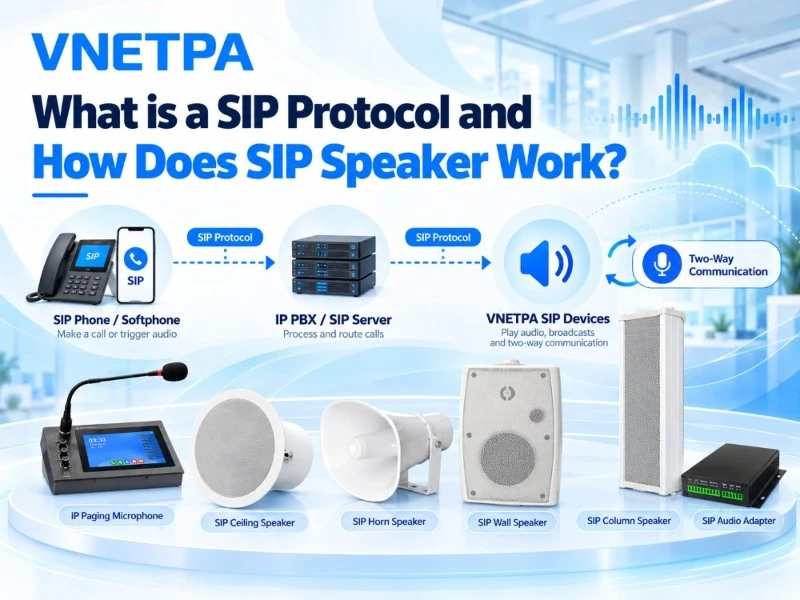
1. What Is SIP Protocol?
SIP (Session Initiation Protocol) is a communication signaling protocol used to establish, manage, and terminate voice or multimedia sessions over IP networks.
It is widely used in VoIP phones, IP PBX systems, SIP speakers, video intercoms, and other network communication devices.
SIP manages the communication session, while protocols such as RTP (Real-time Transport Protocol) carry the actual audio data.
The main functions of SIP include:
Device Registration: Connect SIP devices to an IP PBX or SIP server.
Call Establishment: Initiate voice communication between SIP endpoints.
Session Management: Manage active calls and communication sessions.
Call Termination: End communication sessions when required.
Device Interoperability: Enable communication between compatible SIP-based devices and systems.
For example, a SIP phone can call a SIP speaker through an IP PBX, allowing users to make live announcements without a traditional analog PA system.
2. How Does a SIP Speaker Work?
A SIP Speaker is a network-enabled speaker that supports SIP communication and receives audio through an IP network.
Unlike traditional analog speakers, SIP speakers generally include a network interface, audio decoder, and built-in amplifier, allowing them to receive and play digital audio directly.
The typical SIP speaker communication process includes:
Step 1: Connect to the Network
Connect the SIP Speaker to a LAN using an Ethernet cable. Depending on the model, the speaker can be powered by PoE or an external power supply.
Step 2: Configure the SIP Account
Log in to the speaker's web interface and configure the SIP account, including the SIP server address, extension number, and password.
Step 3: Register with an IP PBX
The SIP Speaker registers with a compatible SIP server or IP PBX, such as 3CX, Asterisk, or Yeastar.
Step 4: Make a SIP Call
A user makes a SIP call from an IP phone, softphone such as Linphone, or another SIP-compatible device to the speaker's extension.
Step 5: Play Audio Through the Speaker
Once the call is established, the speaker receives the audio stream over the network, decodes it, and plays the announcement through its built-in amplifier.
Typical SIP Communication Flow:
SIP Phone / Linphone → IP PBX / SIP Server → Vnetpa SIP Speaker → Live Audio Broadcasting
Certain Vnetpa SIP speakers also support Direct IP Call, allowing compatible devices to communicate directly without registering to an external SIP server.
In addition, supported RTP multicast functions can distribute audio to multiple speakers for group broadcasting. RTP multicast is a separate audio distribution mechanism that can complement SIP communication.
3. Vnetpa SIP-Compatible Products and Their Functions
Vnetpa provides a wide range of SIP-compatible IP audio products designed for different broadcasting and communication requirements.
SIP Horn Speakers
Vnetpa SIP Horn Speakers are designed for outdoor announcements and industrial paging applications.
With SIP compatibility, users can call the horn speaker from a SIP phone or IP PBX to broadcast live voice messages.
Typical applications: School playgrounds, factories, parking areas, warehouses, and outdoor emergency announcements.
SIP Ceiling and Wall-Mounted Speakers
Vnetpa offers SIP Ceiling Speakers and SIP Wall Speakers for indoor audio broadcasting.
These speakers can receive SIP calls from compatible phones or PBX systems to deliver voice announcements directly to selected areas.
Typical applications: Classrooms, corridors, offices, hospitals, retail stores, and shopping malls.
SIP Column Speakers
Vnetpa SIP Column Speakers provide network audio broadcasting for large or extended spaces.
They can be integrated with SIP-based paging systems to deliver announcements across different areas.
Typical applications: Transportation facilities, large halls, outdoor walkways, campuses, and public areas.
SIP IP Intercoms
Vnetpa IP Intercoms support SIP-based communication, enabling two-way conversations between intercom devices, SIP phones, and compatible communication systems.
For example, a visitor or patient can press an intercom call button to contact a reception desk or security office through a SIP connection.
Typical applications: Building entrances, hospitals, parking facilities, emergency call points, and access control systems.
IP Paging Microphones
Vnetpa IP Paging Microphones, such as the NS-M20, support SIP communication, direct calls, and RTP multicast paging.
Operators can use paging microphones to make live announcements, communicate with SIP devices, or broadcast to selected speaker groups.
Typical applications: School offices, factory control rooms, security centers, and commercial buildings.
SIP Paging Adapters and IP Amplifiers
Vnetpa SIP Paging Adapters and SIP-compatible IP Amplifiers provide a flexible way to connect traditional audio equipment with modern IP communication systems.
A SIP Paging Adapter can receive a SIP call and output audio to connected speakers or other compatible equipment.
Similarly, SIP network amplifiers can receive IP audio and drive conventional passive speakers, allowing existing analog PA installations to be incorporated into an IP paging system.
Typical applications: Offices, factories, warehouses, hotels, and upgrading existing analog PA systems.
SIP IP Boards
Vnetpa also provides SIP-compatible IP Boards for integration into customized speaker, intercom, and communication equipment.
These modules help manufacturers and system integrators develop SIP-based audio products without designing the complete network communication hardware from scratch.

4. SIP Speaker Applications in Different Environments
With SIP communication, Vnetpa products can be combined to create flexible IP audio and paging solutions for various industries.
Schools and Campuses
SIP Ceiling Speakers can be installed in classrooms, while SIP Horn Speakers cover playgrounds and outdoor areas. Administrators can make announcements through SIP phones or IP Paging Microphones.
Hospitals and Healthcare Facilities
SIP Speakers provide announcements in corridors and waiting areas, while IP Intercoms enable communication between patients, medical staff, and nursing stations.
Factories and Warehouses
SIP Horn Speakers and IP Amplifiers can deliver production notifications, shift-change announcements, and safety messages. Existing SIP phones can be used for remote paging.
Shopping Malls and Office Buildings
SIP Ceiling and Wall Speakers can broadcast daily announcements, visitor notifications, and other messages through an existing IP communication network.
Security and Emergency Communication
SIP Intercoms and Speakers can be integrated into compatible security systems to support two-way communication, alarm notifications, and emergency paging.

5. Benefits of SIP-Based IP Audio Systems
Compared with traditional analog PA systems, SIP-based solutions offer several advantages:
Standardized Communication: Connect compatible devices from different SIP manufacturers.
Easy Integration: Work with SIP phones, IP PBX systems, and VoIP platforms.
Flexible Remote Paging: Make announcements through SIP phones or softphones.
Scalable Deployment: Expand the system by adding more network devices.
Two-Way Communication: Support intercom functions on compatible devices.
Reduced Cabling: PoE-supported devices use one network cable for power and data.
Centralized Management: Combine SIP devices with compatible IP PA management software.
Vnetpa also offers VNet PA System Software, supporting SIP communication, zone management, live paging, scheduled broadcasting, and centralized management of compatible IP audio devices.
Contact Us:
Email: sales@vnetpa.com